


Blue Film (2025): Bold Ideas, Hollow Characters
Thanks to its controversial subject matter, Elliot Tuttle’s latest film has been hailed as the boldest, most transgressive piece of cinema to have graced the screen in recent memory. Helmed by two powerhouse performances, this chamber drama concerns a cam-boy, Aaron, spending the night with a client for fifty-thousand-dollars, only to discover his patron is connected to a past he thought he left behind. I appreciate the bold formal choice of having the bulk of the narrative unfold over the course of a single conversation, and while it certainly is commendable how Tuttle was able to bring such a light, human touch to such intensely controversial topics, there’s a thinness to the characters, and a didacticism to the dialogue, that ultimately made this critical darling fall flat for me.
We very quickly understand what type of cam-boy Aaron is thanks to a fairly explicit opening where we take the role of his viewers; and while there are several times throughout the script where he mentions his sex work, including a particularly interesting scene where he revels in the ‘spiritual’ aspect of intimately dominating someone, I don’t think this is ever really interrogated. We get some hints that Aaron’s past connection to this character may have crossed boundaries into a kind of grooming, and maybe that has left him desperate for control, but those inferences are really all we have, and I have a few problems with that. In a film this dramatically sparse, the dialogue has to reveal character. While the film keeps us at a deliberate distance from its characters—both repeatedly insisting they don’t know why they are the way they are—that ambiguity eventually begins to feel less like psychological complexity and more like avoidance. We never really know Aaron himself, which feels like the film failing to deliver when it sets the character up with lines like “I want to rap* these fu**ng fa***ts ‘cos that’s all I’m good at.” That’s a really loaded line, but the film never gets to the underlying emotional core, which is interesting since the dialogue is so heavy-handed.
It’s easy for movies centered mostly around a single conversation to feel pretentious. I think a lot of that comes from the lines feeling less like they’re being spoken by someone with the character’s established personality and more from the director sorting through a kind of philosophical discourse by way of dialogue; and that’s something that I felt in a number of scenes during this short runtime. The contrast with Ira Sachs’ latest masterpiece, Peter Hujar’s Day, is revealing, because whereas Sachs’ script focuses on keeping the conversation…conversational, Tuttle’s dialogue doesn’t consider the characters’ personalities at all. It’s almost as if the characters as people disappear and we’re instead watching a kind of fleshy avatar embody Tuttle’s warring thoughts on these topics, making the actors’ amazing commitment all the more frustratingly underused.
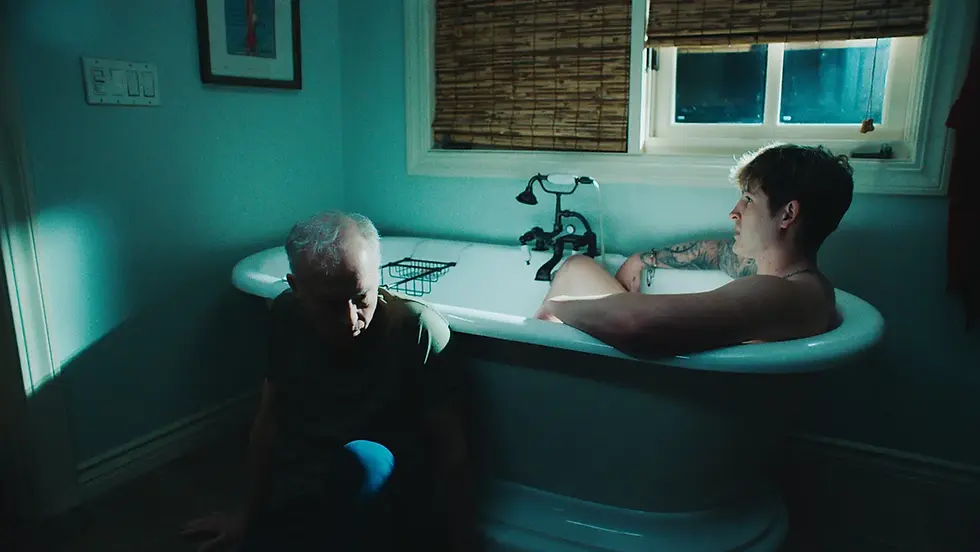
Reed Birney’s role as Hank, the pederast, is one of the better performances I’ve seen this year, maybe ever. In a role that most would assume to be slimy, creepy, or predatory, Birney brings a fragile humanity that creates a really interesting tension with the character himself. We almost feel bad for Hank as he recounts the abuse he himself underwent as a child; but the film never slips into apologia thanks to the fiery counterbalance of Kieron Moore’s portrayal of Aaron. Aaron feels like such a lost person, and that’s most apparent whenever Hank tries to get him to open up only to be shut out by a loud and sudden outburst. Both actors show a serious commitment to their roles and approach their characters as real, well-rounded individuals, even if the script doesn’t.
This movie has gotten a lot of love critically; people clearly connected with it on the festival circuit (even now it sits at a Rotten Tomatoes score of over 90%), but to me the fact that we never get close to the characters almost makes me wonder why the film exists at all. Right now, it’s two broken people coming together for a night to try and find answers where there are none, and while that may be enough for some critics, for me it’s hard to justify sitting through the content this film contains for any runtime, even one this short. Visually, it’s much flatter than Sachs’ film, so the visually dynamic composition that would be needed to sustain a talk-heavy chamber piece isn’t there. For a film so intent on confronting darkness, Blue Film seems content with empty gestures and failed revelations.
Comments